
In September 2026, world leaders met in New York for the high-level week of the 81st session of the UN General Assembly. By the close of the general debate on 28 September, artificial intelligence had become one of the session's most discussed subjects. The President of the General Assembly, Khalilur Rahman, noted that 128 delegations had raised artificial intelligence in the Assembly Hall this year, compared with only five four years earlier. Many of these statements returned to three concerns, namely who controls AI, how it is held to account, and whether its benefits are shared equitably.
This shift was visible throughout the high-level week, as heads of state and government, including from Africa, made notable contributions to the discussions. On the opening day, a group of 23 leaders, including the Presidents of Kenya and South Africa, published a call for international control of frontier AI models. On the same day, President Trump told the Assembly that the United States "totally rejects any attempt to construct a globalist scheme" to control artificial intelligence. The following day, the chief executives of OpenAI, Anthropic and Hugging Face briefed the Security Council alongside Yoshua Bengio, co-chair of the UN's new Independent International Scientific Panel on AI.
This blog argues that African priorities gained significant recognition at UNGA81, but that recognition has not yet translated into resources or decision-making power. Closing that gap requires a path into the global AI agenda that Africa shapes and leads itself. Such a path would start from the priorities already set out in the African Union's Continental AI Strategy and in national strategies, build on institutions the continent already has, particularly its data protection authorities, combine domestic and pooled finance with external support, and coordinate African positions so that the continent's 54 votes at the UN carry weight.
The Road to New York
The focus on AI at UNGA81 had been building for some time, through a sequence of institutional developments within and beyond the UN, some of which are set out below.
2024: Establishing the foundations
In 2024, the General Assembly adopted its first two resolutions on artificial intelligence. The first, led by the United States and adopted in March, addressed safe, secure and trustworthy AI systems for sustainable development. The second, led by China and adopted in July, focused on international cooperation for AI capacity building. Both were adopted by consensus, with the support of African member states.
In the same month, the African Union Executive Council endorsed the Continental AI Strategy in Accra, giving the continent a common reference point for AI development and governance. In September 2024, member states adopted the Global Digital Compact as part of the Pact for the Future. The Compact committed states to building AI capacity in developing countries, to establishing a scientific panel and a global dialogue on AI, and to exploring voluntary financing options for AI capacity building.
2025: Creating the UN's AI institutions
In July 2025, the Secretary-General issued a report on financing options for AI capacity building which, among several options, proposed a Global Fund for AI with an initial commitment of between US1billionandUS3 billion. In August 2025, the General Assembly adopted resolution 79/325, which established two new bodies: the Independent International Scientific Panel on AI and the Global Dialogue on AI Governance. Neither body is a regulator. The panel's role is to provide evidence-based scientific assessments of AI's opportunities, risks and impacts, and the dialogue provides a forum in which all member states can discuss international cooperation on AI governance. The dialogue was formally launched in New York on 25 September 2025, during the 80th session of the General Assembly.
2026: The first year of operation
In July 2026, the scientific panel, made up of 40 experts and co-chaired by Yoshua Bengio and Maria Ressa, published its preliminary report. The report found that the United States "accounts for 75% of the computing power among the world's top 500 AI supercomputers, with China accounting for 15%", and that companies in those two countries "develop almost all leading general-purpose models". It also concluded that "most countries, including many advanced economies, lack the technical expertise to assess the most capable 'frontier' models or to participate meaningfully in their governance". Eight of the panel's members are African researchers, including Vukosi Marivate, Joyce Nakatumba-Nabende, Rita Orji, Awa Bousso Dramé and Adji Bousso Dieng.
The first Global Dialogue on AI Governance took place in Geneva on 6 and 7 July 2026. It brought together more than 3,000 participants, with delegations from 163 countries. The co-chairs' summary records a position long advanced by African and other developing-country delegations, that "the key challenge is no longer access to AI, but the capacity to shape, govern and benefit from it". Ministers from Gabon and Senegal were among the African participants.
On 11 September 2026, shortly before the high-level week, the Secretary-General issued a further report on the challenges developing countries face in AI capacity building (A/80/817). It found that financing for AI capacity building remains fragmented and proposed a needs-based fund with initial commitments of US$3 billion over two to four years. The report also noted that high-income countries held 77% of global data centre capacity as of June 2025, compared with less than 0.1% in low-income countries.
Developments beyond the UN
Other initiatives developed alongside the UN process. On 16 July 2026, China launched the World AI Cooperation Organization (WAICO) in Shanghai with 29 founding signatories, at least ten of which are African, including Kenya, South Africa, Ethiopia and Senegal. The United States, for its part, has pursued its American AI Exports Program, through which consortia of US companies offer partner countries "full-stack" packages of American hardware, cloud services, models and security, supported by priority export licensing, diplomatic advocacy and assistance in securing federal financing (Just Security). Within Africa, the African Union's Infrastructure and Energy Department held an open consultation on AI governance on 23 and 24 September 2026, coinciding with the high-level week, to support the implementation of the Continental AI Strategy as the AU prepares draft guidelines and a model law for ministerial review.
Taken together, these developments meant that UNGA81 was the first General Assembly session after both of the UN's new AI bodies had become operational. It also continued a pattern of overlapping commitments that predates New York. African governments have endorsed the declarations of successive global AI summits, as set out below. The State of AI Regulation in Africa report (2024) documents further international alignment by African governments and regulators.
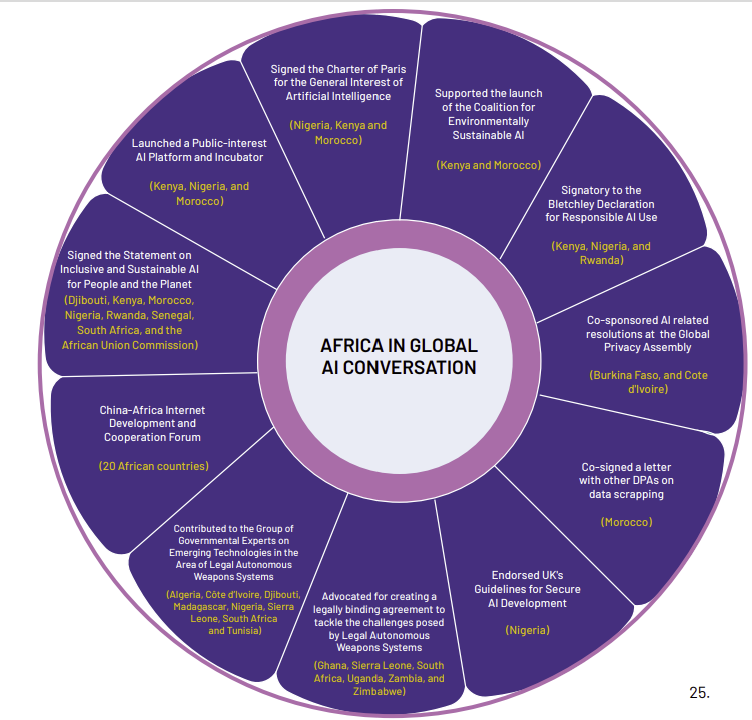
Source: State of AI Regulation in Africa: Trends and Developments Report, 2024
The main milestones on the road to New York are summarised below.
|
Date |
Milestone |
Significance for Africa |
|
March 2024 |
US-led General Assembly resolution on safe, secure and trustworthy aI |
Adopted by consensus with African support |
|
July 2024 |
China-led General Assembly resolution on AI capacity building |
Capacity building placed on the UN agenda |
|
July 2024 |
AU AI Continental Strategy endorsed in Accra |
A common African position on AI development and governance |
|
September 2024 |
Global Digital Compact adopted |
Commitments to AI capacity building, a scientific panel, a dialogue and financing options |
|
July 2025 |
Secretary General’s report on financing options (A/79/966) |
First proposal for a Global AI Fund ranging from $ 1- 3 billion |
|
August 2025 |
Resolution 79/325 establishes the panel and the dialogue |
The UN’s first standing AI bodies |
|
September 2025 |
Global Dialogue launched in New York |
A universal forum in which every African state has a seat |
|
July 2026 |
Scientific panel’s preliminary report |
Evidence on the concentration of compute and models |
|
6-7 July 2026 |
First Global Dialogue, Geneva |
Capacity, compute and language gaps were noted in the co-chairs’ summary |
|
16 July 2026 |
WAICO founded in Shanghai |
Ten African founding members |
|
11 September |
Secretary-General’s report on developing countries' AI capacity (A/80/817) |
Proposed fund of $3 billion over two to four years |
|
23-24 September 2026 |
AU open consultation on AI governance |
Draft continental guidelines and a model law move towards ministers |
AI Deliberations at UNGA81
For African governments, UNGA81 served as a test of whether the continent's arguments about AI had begun to shape the global agenda. The outcome was mixed. African states arrived in New York with a clear and consistent account of the AI divide. It ranged from shortages of compute, energy, data, skills and finance to the under-representation of African languages in the systems now being deployed across the continent. This assessment is now reflected in official UN texts, including the co-chairs' summary of the first Global Dialogue on AI Governance and the Secretary-General's September 2026 report on AI capacity building. What remains absent are financial resources, institutional influence and enforceable commitments.
The week also highlighted a pattern of multi-alignment among some African governments. Kenya and South Africa, both founding members of China's World AI Cooperation Organization since July, endorsed the European-led call for control of frontier AI models during the week. Kenya also concluded a cooperation declaration with Anthropic. On the sidelines of the Assembly, President Ruto and US Secretary of State Marco Rubio discussed cooperation on critical minerals, including the niobium and rare earth deposits at Mrima Hill, which lie at the beginning of the AI supply chain. Kenya has made local processing a condition of any agreement, although no deal had been signed by the end of the week. Whether these steps reflect a deliberate strategy or a series of separate decisions, they place these governments within several competing approaches to AI governance at the same time.
The sections that follow examine what took place in New York, the priorities African leaders advanced, the extent to which Africa gained ground, and the developments that African policymakers, regulators and civil society should monitor over the next twelve months.
What happened in New York
The week brought several competing positions on the governance of frontier AI into public view, and African states took part in a number of the key discussions.
-
A call for control of frontier models. Twenty-three leaders, including President William Ruto of Kenya and President Cyril Ramaphosa of South Africa, endorsed "A Call for Control of Frontier AI Models". The statement calls on companies to adopt transparent safety protocols, "including mandatory pre-deployment testing and independent evaluation". It calls on governments to develop common standards and to report serious safety incidents. It also urges UN member states to "explore creating an international institution, able to set standards, enable verification". Most of the other signatories were European, joined by leaders from Australia, Bahrain, Canada, Kazakhstan, Singapore, Türkiye and the United Arab Emirates. The United States, China, the United Kingdom, France, India, Japan and South Korea did not sign. Kenya and South Africa were the only African signatories at the time of publication, although the statement remains open for endorsement.
-
The United States' rejection of multilateral oversight. In his address to the Assembly, President Trump stated that the United States "totally rejects any attempt to construct a globalist scheme" to control AI, and that he was "not going to stifle growth of something that will be bigger than the Industrial Revolution". He also referred to AI as "superintelligence" and indicated that US government documents would adopt that term. This position is consistent with the one the United States took in September 2025, when Michael Kratsios, Director of the White House Office of Science and Technology Policy, rejected "centralized control and global governance" of AI at the Security Council.
-
A Security Council briefing on loss of control. France's Minister for Europe and Foreign Affairs, Jean-Noël Barrot, chaired a high-level Council briefing by Yoshua Bengio, Sam Altman, Dario Amodei and Clément Delangue. According to Security Council Report, the Council had previously held six formal and informal meetings on AI, and this was the first to focus specifically on safety risks and the loss of human control. Two of the Council's African members used the meeting to place the continent's concerns on record. Somalia warned against "new forms of technological dependency and digital colonialism" and stated that developing countries require "targeted international cooperation" and financing to close their digital, energy and skills gaps. The Democratic Republic of the Congo stated that developing countries "cannot be reduced to the role of mere users of technologies designed elsewhere". The United States, represented by Michael Kratsios, again rejected "any attempt to construct a globalist scheme of control".
-
The Secretary-General's final address. With approximately 100 days remaining in his term, António Guterres used his final address to the General Assembly to warn that "power increasingly comes from data, computing capacity, and algorithms. And this new power is highly concentrated." He called for "the responsible pacing of AI" and for "a multilateral AI risk management framework supported by credible and independent oversight". He also called on the countries leading the technology to "cooperate on testing and evaluation". He further set out two limits: "Killer robots must have no place in our future", and children "must never become the test subjects for unregulated systems".
-
China's more limited presence. President Xi did not attend the session. Vice President Han Zheng told the Assembly that China takes "a people-centered approach" to AI and seeks to "develop AI for the positive and for good, narrow the digital divide, and promote development that is universally beneficial". He also called for greater support for countries of the Global South. China did not sign the call for control of frontier models. Its principal multilateral AI initiative, the World AI Cooperation Organization (WAICO), operates outside the UN framework, but it formed part of the background to the debate, given that several of the governments present are among its members.
Around these headline moments sat a dense programme of side events. The UN Office for Digital and Emerging Technologies hosted Digital Cooperation Day on 21 September. On 24 September, the African Development Bank Group, the UNDP AI Hub for Sustainable Development, Google and Apolitical jointly launched free AI training for African public officials, with courses developed by Stanford University Online and SDA Bocconi School of Management. Kenya also continued its engagement on child protection, having joined the Coalition for Children's Rights and Protection in the Age of Artificial Intelligence as a founding member when UNICEF, France and Spain launched it in Geneva in July.
What African leaders said and asked for
African delegations addressed AI less in their general debate speeches than in side events, bilateral meetings and signed declarations. The main podium speeches concentrated on Security Council reform, debt and the cost of capital. President Ruto's address, for example, drew particular attention for its arguments on Security Council reform and the cost of capital. In AI diplomacy, three themes ran through the statements and engagements of African leaders.
The first is a desire to move from consumer to producer. Guinea's Minister of Higher Education and Scientific Research, Djami Diallo, stated that "Africa must no longer only consume AI. It must also become a creator of it." Kenya's delegation argued that Africa should become a builder of technologies rather than remain dependent on systems developed elsewhere. South Africa told the Assembly that "Africa must have a stake in shaping the rules" governing AI. At the Security Council, Somalia warned against "new forms of technological dependency and digital colonialism", and the Democratic Republic of the Congo stated that developing countries "cannot be reduced to the role of mere users of technologies designed elsewhere". Together, these statements present the current pattern, in which Africans mostly use AI systems built elsewhere, as a risk of renewed dependency.
The second is extraction. Sierra Leone's Chief Minister, David Moinina Sengeh, warned against data extraction that repeats historical patterns of exploitation. This concern echoes what other African leaders said in the general debate about minerals. President Bio of Sierra Leone argued that "the green transition must not reproduce the extractive terms of the past". Zimbabwe called for mineral beneficiation and value addition at source, and Ghana criticised an economic model based on the export of raw materials. The AI supply chain begins with minerals such as cobalt, copper and rare earths, many of which African states export, and continues with the data that African users generate. Taken together, these statements suggest that African leaders increasingly see both as part of the same policy problem: how to retain more of the value on the continent.
The third is foundations. Rwanda's Prime Minister, Justin Nsengiyumva, argued that "AI cannot thrive on algorithms alone", pointing to the decades of investment in digital infrastructure that preceded Rwanda's AI readiness. Mary-Ann Etiebet of Vital Strategies made a related point in a commentary after the week: nearly half of children under five in sub-Saharan Africa do not have their births registered, and AI systems cannot serve populations that are absent from the underlying data. The African Development Bank's estimate that inclusive AI deployment could add up to US$1 trillion to Africa's GDP by 2035 depends on these foundations being in place.
Where Africa gained ground and where it did not
Africa's most significant gain at UNGA81 was the incorporation of its priorities into the language of global AI governance. The distribution of resources and decision-making power, however, remained largely unchanged.
-
Gains
African priorities are now reflected in official UN texts. Positions that African and other developing-country delegations have argued for several years now appear in UN documents. The Geneva co-chairs' summary calls for countries to be treated "as active participants in, not passive recipients of, AI's design and deployment", names "digital sovereignty" and "reduced dependency on foreign technologies" as priorities, and states that linguistic and cultural inclusion should be "a design requirement rather than an afterthought". The same summary endorses "smaller, efficient, context-appropriate models running on existing infrastructure", which describes the kind of AI most African institutions can realistically build and run.
African expertise informs the UN's scientific assessment of AI. Eight of the 40 members of the scientific panel are African researchers. This matters because the panel shapes which evidence informs global debate. The co-chairs' summary notes the panel's call for "stronger evidence from developing countries", which gives African universities and research networks a clear opening to supply it.
Africa's 54 member states form a substantial bloc in the Global Dialogue, a universal forum in which they can exercise significant collective influence. Africa's 54 UN member states make up more than a quarter of the General Assembly. In a forum that works through consensus and agenda-setting, a coordinated African group could exercise real influence over what the 2027 dialogue discusses.
-
Gaps
Financing remains limited and voluntary. The proposed Global Fund for AI has an indicative target of US$3 billion over two to four years, to be shared among all developing countries (A/80/817). By comparison, the implementation of Kenya's National AI Strategy 2025–2030 alone is estimated at KES 152 billion, approximately US$1.2 billion, and reporting indicates that no dedicated parliamentary allocation has yet been made. Should the fund be established, it would therefore meet only a small proportion of the financing needs already identified in African national strategies.
The bilateral agreements concluded during the week were not supported by financial or institutional commitments. Kenya's joint declaration with Anthropic and its memorandum of understanding with Stanford University's Hoover Institution were both signed in New York without provision for funding, personnel or implementation timelines. The Anthropic declaration nonetheless requires both parties to process data in accordance with Kenya's data protection and cybersecurity legislation, which establishes a useful precedent for future agreements. Training initiatives for public officials, such as the programme launched by the African Development Bank Group and its partners, are likewise of value; however, they do not address the more fundamental requirements of compute capacity, data infrastructure and research funding.
Decisions on frontier AI continue to be taken outside Africa. The Security Council briefing, arguably the most consequential AI discussion of the week, was chaired by France and heard from a Canadian scientist and the chief executives of three AI companies headquartered in the United States. Although Somalia and the Democratic Republic of the Congo used the meeting to raise developing-country concerns, the briefers who shaped the discussion came from outside the continent. The leaders' call for control of frontier AI models proposes mandatory pre-deployment testing and urges states to explore creating an international institution to set and verify standards. It does not, however, specify how African regulators would take part in such arrangements. This is a significant omission, given the scientific panel's finding that "most countries, including many advanced economies, lack the technical expertise to assess the most capable 'frontier' models or to participate meaningfully in their governance".
On evaluation and oversight, however, Africa already has functioning regulators with powers over a key input to AI systems: personal data. Most African states now have data protection laws, and several authorities, including those in Kenya, Nigeria and South Africa, have begun issuing determinations and fines. The reference to Kenyan data protection law in the Anthropic declaration shows how these existing laws can anchor new AI agreements. Building AI oversight on data protection institutions is likely to be faster than waiting for new AI regulators to be created.
Competing approaches to AI governance and a pattern of African multi-alignment
The significance of the week's agreements for Africa becomes clearer when they are considered together. Kenya and South Africa, two of the African states most active in AI diplomacy during the week, are now associated with more than one of the principal approaches to AI governance at the same time.
China's approach. Kenya and South Africa are both founding members of WAICO, established in Shanghai on 16 July 2026 alongside other African founding members. WAICO emphasises the adoption of open-source AI and support for "digital development in the Global South". No G7 or European Union member state is among its founding members.
The European-led safety approach. On 22 September 2026, Presidents Ruto and Ramaphosa endorsed the call for control of frontier AI models. The statement calls on companies to adopt safety protocols that include mandatory pre-deployment testing and independent evaluation, and urges member states to explore the creation of an international institution able to set standards and enable verification. European leaders account for just over half of its 23 signatories, alongside leaders from Australia, Bahrain, Canada, Kazakhstan, Singapore, Türkiye and the United Arab Emirates.
The United States' market-led approach. The US government rejects multilateral oversight of AI while actively promoting American technology abroad, and favours voluntary frameworks and technical standards over mandatory pre-release approval. Through its American AI Exports Program, consortia of US companies offer partner countries "full-stack" packages of hardware, cloud services, models and security, supported by priority export licensing, diplomatic advocacy and assistance in securing federal financing. Kenya's engagement with this approach has so far taken place mainly through companies. In addition to its declaration with Anthropic, Kenya is reported to be in discussions with OpenAI, Google, Microsoft, Meta, NVIDIA, Mistral and Cohere. AI was also among the subjects President Ruto discussed with US Secretary of State Marco Rubio in New York. There is no comparable public record of agreements between South Africa and US AI companies.
This pattern has an evident rationale. No single approach offers African governments everything they require. China offers infrastructure, open models and a development-oriented framing. The European-led approach offers a rules-based framework and a voice in the setting of safety standards. US companies, which together with Chinese firms develop almost all leading general-purpose models, offer access to many of the most capable systems and, increasingly, direct partnerships with governments. Engagement with several approaches keeps options open and may strengthen the bargaining positions of African governments. It is not yet clear, however, whether this reflects a deliberate strategy or a series of separate decisions.
This approach also carries risks that African policymakers should weigh carefully.
-
Commitments may conflict. The call for control of frontier AI models envisages independent evaluation and verification of the most capable models. WAICO's emphasis on open-source diffusion and the US preference for voluntary standards point in different directions. Over time, a government may find that commitments made in one forum constrain what it can accept in another.
-
Bundled offers can create dependency. Packages that combine hardware, cloud services and models from a single provider form integrated ecosystems that can make switching to other suppliers costly. Such offers are available from several governments and companies. A country that adopts an integrated package from one provider may later find it difficult or expensive to diversify.
-
Signing agreements is easier than implementing them. Multi-alignment tends to produce a growing number of declarations and memoranda, each of which requires sustained follow-up by officials. Without a clear national framework setting out the purpose of each partnership, governments risk accumulating agreements they lack the capacity to implement.
-
Continental coordination becomes more difficult. The African Union is working to harmonise data governance, cybersecurity standards, regulatory sandboxes and the coordination of compute and energy infrastructure across its 55 member states. When leading African states join different external arrangements on different terms, a common African position becomes harder to build.
What to watch before UNGA82
The coming twelve months will indicate whether the recognition African priorities gained during 2026 translates into resources and influence. Seven developments merit close attention.
-
The Global Fund for AI. The Secretary-General's September 2026 report on AI capacity building, which proposes a needs-based fund with initial commitments of US$3 billion over two to four years, is now before member states (A/80/817). The principal questions are whether the General Assembly endorses such a fund during its 81st session, which states make pledges, whether the proposed scale is maintained, and what role African governments will play in decisions on allocation.
-
The second Global Dialogue on AI Governance, New York, 3–4 May 2027. The co-chairs of the Geneva dialogue called for the early nomination of the next co-chairs, "adequate and predictable funding from the outset", funding and visa arrangements for delegations without the means to attend, and more senior participation from the private sector, particularly frontier AI developers. The appointment of an African co-chair, or an African-led thematic session on language and data, would be a meaningful indication of the continent's influence.
-
The scientific panel's next report. The panel's next annual report is intended to inform the second Global Dialogue in May 2027. The panel has identified the need for stronger evidence from developing countries. African panel members and research networks therefore have an opportunity to contribute evidence on AI adoption, language performance and harms in African contexts.
-
The African Union's model law. Following the AU's open consultation in September 2026, the AU is preparing draft continental guidelines and a model law on AI governance for ministerial review. Whether the text builds on existing data protection law, and whether it addresses the coordination of compute and energy infrastructure, will shape national legislation for years to come.
-
Further endorsements of the call for control of frontier AI models. The statement remains open for endorsement by other leaders. Additional African signatures would strengthen the continent's position in any future international verification institution. If no further African states sign, the reasons will merit examination, whether they lie in limited technical capacity, alignment with the United States or China, or a judgement that other priorities are more pressing.
-
WAICO in practice. WAICO's first programmes, and whether they provide compute, training or open models to its African founding members, will show whether membership delivers tangible benefits.
-
National implementation in Kenya. The principal tests are financing for the National AI Strategy, the establishment of the planned AI Safety Institute, and the management of AI-generated political content ahead of the 2027 general election. Anthropic's September 2026 threat report identified a Kenyan actor using its model to generate political posts, although the company found no government involvement and assigned the case its lowest threat rating.
A change in UN leadership adds a further element of uncertainty. António Guterres has made AI governance a priority of his tenure, and his term ends on 31 December 2026. The priorities of his successor will influence how actively the Secretariat supports the fund, the dialogue and the scientific panel.
Conclusion
UNGA81 confirmed that AI is now a standing subject of global diplomacy, and that Africa's account of the AI divide has entered the UN's official vocabulary. Capacity, compute, data, language and sovereignty are now the terms in which the UN describes the problem.
The week also showed the limits of that achievement. The financing on offer is voluntary and small relative to need. Decisions on frontier AI are largely shaped by two governments and a small number of companies, none of them African. The bilateral agreements signed in New York record good intentions without budgets.
Some African governments are engaging with Chinese, European and American approaches at the same time. Whether or not this is a deliberate strategy, it can serve African interests if it is guided by clear national and continental priorities, backed by domestic budgets, and anchored in institutions Africa already has, particularly its data protection authorities and the AU's continental framework. That is the substance of an Africa-shaped and Africa-led path in global AI governance. The task between now and UNGA82 is to turn the recognition gained in New York into funded programmes, functioning regulators and African-built systems.